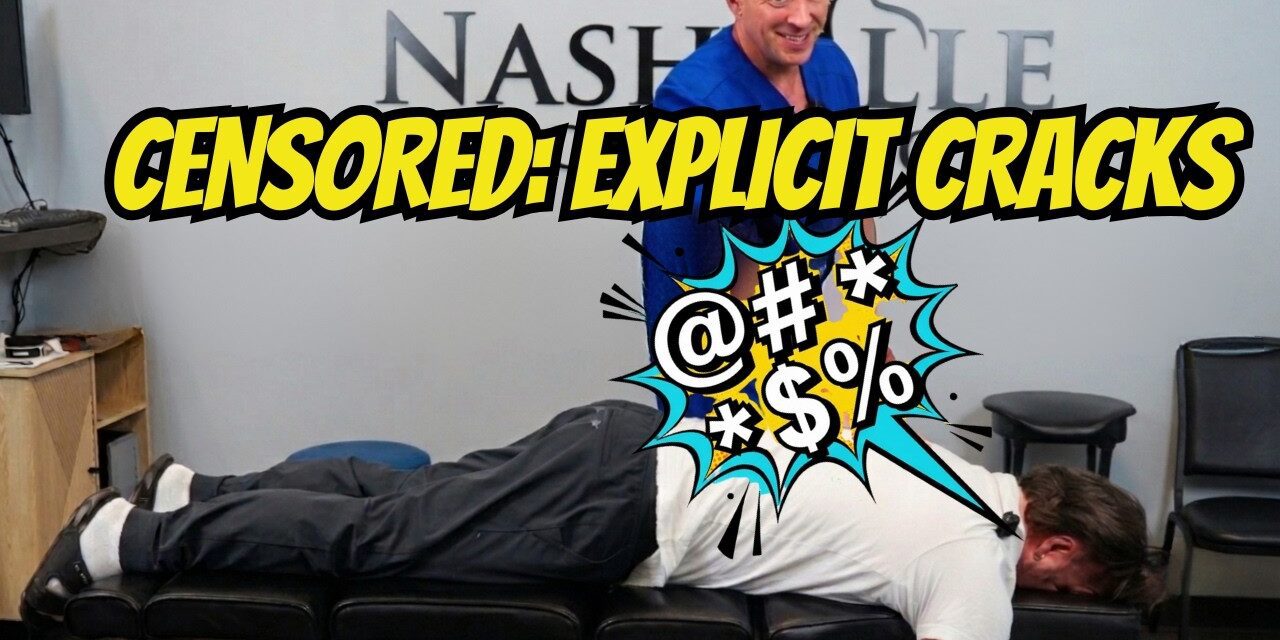
When you spend years in the record industry—whether you’re playing guitar on stage, bent over an acoustic in the studio, or sitting for hours behind a mixing console—your spine takes a massive beating. In this episode at Nashville Neck & Back, Dr. Andy Roberts works with local record label executive, songwriter, and music producer Aaron Chesling.
Aaron came in suffering from a severe, debilitating flare-up of a long-standing lower back injury. The release was so intense and loud that we literally had to bleep out most of the audio during his adjustments!
Watch the full video to see Aaron’s complete treatment, including lumbar drops, deep cervical releases, and the famous Y-strap decompression.
Frequently Asked Questions & Treatment Breakdown
Q: What caused Aaron’s sudden lower back pain flare-up? A: Aaron originally injured his low back over 12 years ago. Recently, he rekindled the herniated disc injury while lifting something heavy without his supportive back brace. This triggered severe, debilitating spasms and shooting pain in his lower right back and hip, leaving him unable to get out of bed for several days.
Q: How does playing guitar and working in the studio affect posture and spine health? A: Musicians and studio producers face unique repetitive stress injuries. Heavy electric guitars hanging on a shoulder strap create uneven spinal loading and neck compression. In the studio, slouching over instruments or mixing consoles for long sessions places immense stress on the lumbar discs.
Q: Can chiropractic adjustments fix a herniated or bulging disc? A: While targeted chiropractic adjustments do not magically make a herniated or bulging disc disappear, they help realign surrounding joint structures, reduce localized inflammation, and relieve nerve pressure. For complete long-term disc healing, a structured series of spinal decompression therapy is recommended.
Q: What is the Y-Strap adjustment and how does it help? A: The Y-strap (Y-axis traction control tool) applies manual axial decompression along the entire spine. By gently stretching the spinal column, it decompresses tight intervertebral discs from the neck all the way down to the lower back, providing rapid pressure relief.
Q: Should you use heat or ice after a high-volume chiropractic adjustment? A: Ice is the best choice following an adjustment when managing acute soreness or disc inflammation. Apply ice for 20 minutes on and 20 minutes off. Direct heating pads should be avoided as they can increase swelling and localized inflammation in acute disc injuries.