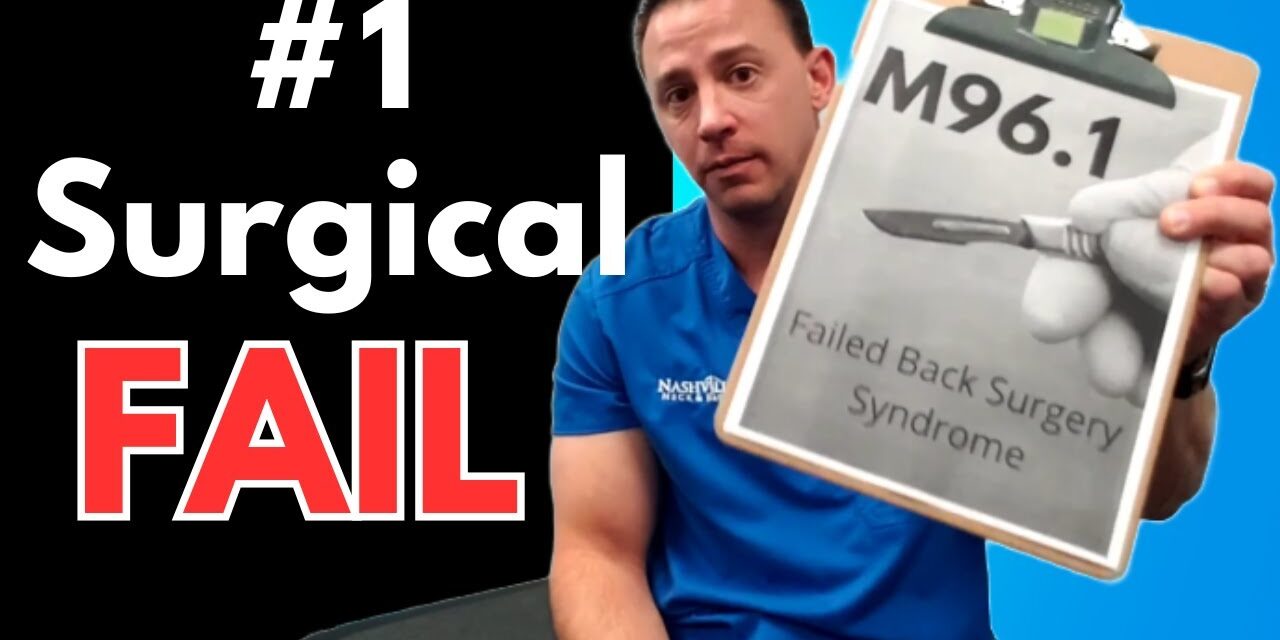
Are you struggling with chronic back pain and feeling like surgery is your only remaining option? Before you “go under the knife,” there is a medical diagnosis code you should know about: M96.1.
This code stands for Failed Back Surgery Syndrome (FBSS). It exists because, unfortunately, back surgeries fail far more often than patients realize.
The Reality of Low Back Surgery
While neck surgeries (cervical fusions or discectomies) often see high success rates, lower back surgeries can be much more unpredictable. Dr. Roberts describes the outcomes for low back surgery as being as uncertain as a coin flip [01:20].
Even when a surgery is initially “successful,” many patients find their symptoms returning within just two years [01:26]. This often leads to a “rabbit hole” of more procedures, more injections, and eventually, more surgeries.
The “Brick Wall” Effect: Why One Surgery Leads to Another
Why does surgery often fail in the long run? Think about a spinal fusion. When two vertebrae are fused together, they become like a brick wall—they no longer move [03:21].
However, your body still needs to bend, twist, and lift. Because the fused joint is stationary, the joints immediately above and below it have to work overtime to compensate. This extra load causes those joints to wear down faster, eventually requiring surgery at those levels as well [03:39].
A More Conservative Path: Spinal Decompression
Surgery is permanent. Once you’ve had it, you can’t go back [03:03]. That’s why we always recommend exploring the most conservative treatment options first.
Non-Surgical Spinal Decompression is a powerful alternative for both the neck and low back. Here’s how it helps:
-
Heals the Disc: It targets the disc material that is bulging or herniating [02:25].
-
Relieves Nerve Pressure: By reducing the bulge, it stops the material from hitting the nerves that cause shooting pain, numbness, and tingling in your arms or legs [02:44].
-
Avoids the Knife: It allows the body to heal naturally without the risks associated with invasive procedures.
Get a Second Opinion Before You Commit
If you’ve been told that surgery is your only option, it’s worth seeking a second opinion to see if you can avoid the “M96.1” diagnosis. Your goal should be to prolong or entirely avoid the surgical route whenever possible [02:04].
Ready to see if Spinal Decompression is right for you? Don’t become a statistic. Contact us today to learn how we can help you find relief without the risks of surgery.