For high-impact athletes like dancers and gymnasts, the physical demands of training can leave a lasting impact on the body long after they step off the mat. Years of backbends, splits, and hard landings build incredible strength, but they also subject the spine, joints, and soft tissues to repetitive micro-trauma. When you layer a stressful daily work environment on top of that physical history, the body eventually hits a breaking point.
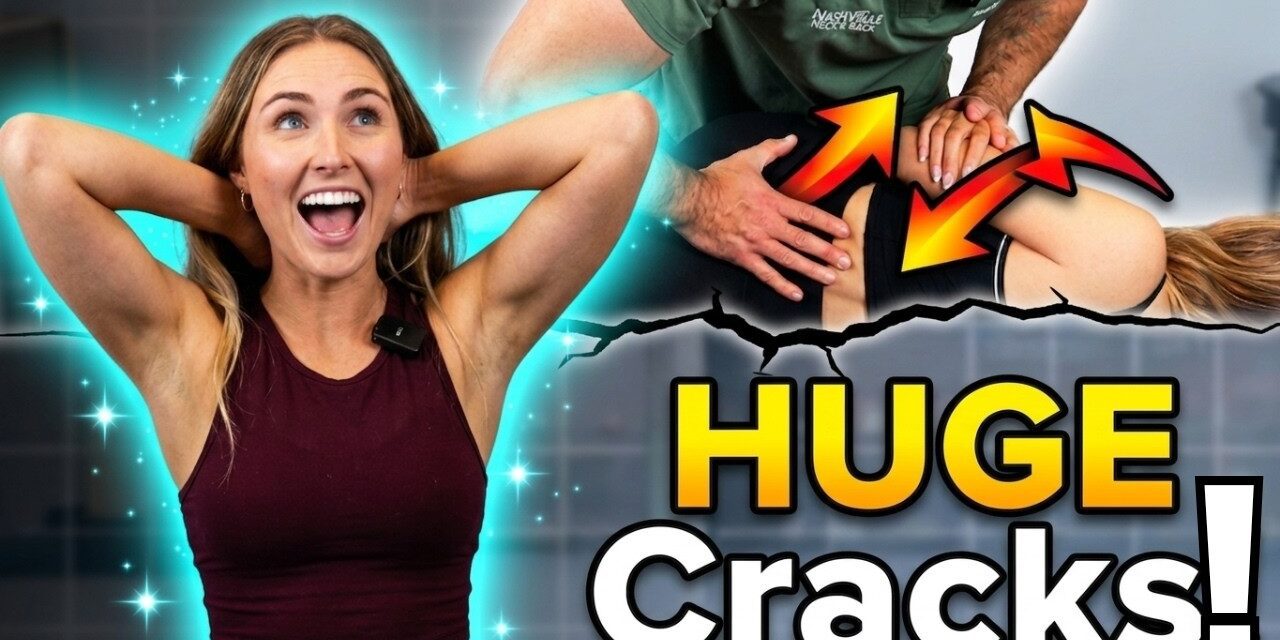
In our latest patient feature, we welcomed Jasmine to the clinic. As a former competitive dancer and gymnast who still performs physically demanding choreography for her job, Jasmine was dealing with severe, chronic structural stress. Her primary complaint was a heavy, constant tightness gripping her neck and tracking down her spine, accompanied by painful neural flare-ups traveling down her arm.
Let’s dive into the clinical breakdown of Jasmine’s first-ever chiropractic adjustment, the therapies used to restore her mobility, and the underlying biomechanics of athletic back pain.
The Clinical Assessment: Checking the Damage from High-Impact Sports
Jasmine’s initial consultation revealed a common pattern seen in former gymnasts. She described a persistent “heaviness” in her cervical spine, noting that by the end of the work day, she felt as though she literally had to support her own head with her hands to achieve temporary pain relief.
During the range of motion testing, several key issues became apparent:
-
Cervical Restrictions: Bringing her ear to her shoulder triggered immediate, sharp tightness on the contralateral side, accompanied by audible joint crepitus (crunching and popping noises) during lateral rotation.
-
Neural Compression: Jasmine noted an intense, fire-like burning sensation down her arm when hitting her “funny bone” (the cubital tunnel region of the elbow), indicating underlying cervical nerve root irritation or structural tension along the ulnar nerve pathway.
-
Thoracic and Lumbar Guarding: Palpation along her shoulder blades elicited severe hypertonicity (muscle guarding). A standard standing toe-touch test confirmed localized mechanical stress radiating across her lower lumbar spine.
Instrument-Assisted Soft Tissue Mobilization (IASTM) & Muscle Scraping
Before executing any spinal adjustments, it is vital to prepare the surrounding soft tissue architecture. For Jasmine, we utilized a specialized metal scraping tool for Instrument-Assisted Soft Tissue Mobilization (IASTM), targeting the hypertonic fibers of her upper trapezius and rhomboid muscles.
There are many pervasive myths surrounding “muscle scraping” on social media platforms like YouTube and TikTok. Let’s clear the air on what this therapy actually does:
-
What it IS doing (Vasodilation): The localized redness (petechiae) that appears on the skin during scraping is simply vasodilation. We are drawing fresh, oxygenated blood flow directly to the surface of the skin and the superficial fascial layers. This process triggers a localized healing response, down-regulates neurologically guarded muscle knots, and makes the subsequent structural adjustment substantially easier and more comfortable for the patient.
-
What it is NOT doing (The Scar Tissue Myth): Many practitioners claim scraping physically “breaks up” deep scar tissue or fascial adhesions. In reality, deep scar tissue is incredibly dense and structurally resilient; a superficial metal tool coated in lotion cannot physically tear or break it apart.
-
What it is NOT doing (The Toxin Release Myth): You cannot scrape “toxins” out of a patient’s back. The human body naturally processes and eliminates metabolic waste through the kidneys, liver, and lymphatic system. To optimize this natural detoxification, you don’t need a metal tool—you simply need consistent hydration, an anti-inflammatory diet, restorative sleep, and regular physical activity.
The Adjustments: Restoring Mobility from the Pelvis to the Skull
Once Jasmine’s musculature was relaxed and warm, we transitioned her to the table for a full-body structural realignment:
1. Thoracic Spine & Side-Posture Lumbar Realignment We began with an anterior thoracic setup to open up her mid-back. This was followed by a side-posture lumbar adjustment to address her lower back pain. Because Jasmine had never experienced a chiropractic adjustment before, her nervous system naturally wanted to resist. By guiding her into a relaxed side-lying position and ensuring her neck remained neutral, we achieved a deep, clean mechanical release across the lumbar facets.
2. Hip Mobilization & Extremity Releases Next, we focused on her lower extremities. Using long-axis distraction pull techniques on her legs, we successfully opened up her sacroiliac (SI) joints and hip sockets, correcting minor functional leg-length discrepancies caused by pelvic rotation.
3. Cervical Spine Adjustments (The Toe-Wiggling Trick) Adjusting the neck of a first-time patient requires careful neurological distraction. Jasmine’s cervical muscles were actively guarding due to natural apprehension. To bypass this subconscious resistance, we utilized a classic clinical distraction technique: asking the patient to focus entirely on actively wiggling their toes. While her brain was occupied coordinating the movement of her feet, we delivered a precise, lightning-fast lateral cervical adjustment, resulting in immediate structural release and loud, satisfying joint cavitation.
4. The Y-Strap Spinal Decompression To finalize her structural realignment, we applied the Y-Strap tool. By securing the specialized strap at the base of the skull and administering a controlled, high-velocity, low-amplitude (HVLA) axial pull, we applied a long-axis decompression force along the entire length of her vertebral column. This instantly reduces intradiscal pressure, opens up the neural foramina, and relieves vertical loading stress.
Why Rhomboid Pain Keeps Coming Back: Posture Tips for Athletes & Office Workers
Following her adjustment, Jasmine noted that the severe, crushing weight under her shoulder blades had completely vanished. However, to keep it from returning, we must look at the muscular imbalances driving the issue.
A massive number of people suffer from chronic pain directly underneath or between the shoulder blades. This area is heavily dictated by the rhomboid muscles, which connect the medial border of your scapula to your thoracic spine.
When you sit hunched over a computer at a desk for hours, drive long distances, or repetitively round your shoulders forward during athletic training, your posture degrades. Your shoulder blades begin to pull outward away from the spine (scapular protraction). This constant forward pulling forces the rhomboid muscles into a chronically overstretched, elongated state. When a muscle is forced to stay stretched out under tension all day, it undergoes ischemic distress, develops painful trigger points, and begins to spasm out of sheer exhaustion.
The “Mind-Muscle” Shoulder Blade Pinch To fix this at home or at your desk, you must consciously reactivate and strengthen these mid-back posture stabilizers. Try this exercise throughout the day:
Imagine there is a baseball or a pencil placed perfectly between your shoulder blades. Without lifting your shoulders toward your ears, pull your shoulders back and focus entirely on squeezing your shoulder blades together to “pinch” that ball. Hold this contraction firmly for 3 to 5 seconds, then release. Performing sets of these throughout the work day rebuilds the neuromuscular connection to your mid-back, pulling your structural frame back into alignment naturally.
Correcting Cable Rows and Band Work If you are performing rows at the gym or using resistance bands at home to fix your upper back posture, you must watch your form. If your biceps are burning or exhausted at the end of a rowing set, you are pulling primarily with your arms rather than your back. Focus on driving your elbows backward and initiating the movement from your shoulder blades first. When done correctly with a proper mind-muscle connection, the middle of your back should feel a deep, productive muscular burn.
Post-Adjustment Evaluation: The Results
Re-checking Jasmine’s functional movement at the end of her visit confirmed an outstanding clinical outcome. The crunching noises, localized restrictions, and lateral neck pain were entirely gone, replaced by smooth, fluid cervical range of motion. For a busy mom of two managing a high-stress workspace, prioritizing regular chiropractic maintenance is the key to preventing old athletic injuries from dictating daily quality of life.